Two studies of questionnaire answering styles
Do changing answers always mean a changing personality?
Two studies examined whether the way people use rating scales can make personality look more changeable. Their results raise a measurement question, not a verdict on people.
In this explanation
What the researchers were concerned about
People may behave differently with friends, family and colleagues. Researchers sometimes study these differences by asking the same personality questions across settings or days, then measuring how much the answers vary.
But people also use rating scales differently. Some often choose the ends of a scale; others stay closer to the middle. This paper asked whether these answering habits could make personality appear more or less variable, even when the changing answers were not all about changing behaviour.
The first study used an unusual comparison
The first study involved 149 university students. They rated their personalities, described themselves in different roles and answered questions about how clear or consistent their sense of self felt. The researchers also asked them to rate cartoon characters and relatively neutral everyday objects.
The logic was that a person’s changing behaviour across roles should not automatically have a strong connection with how differently they rate objects or fictional characters. If these varied ratings were linked, a shared answering habit could be part of the explanation.
The researchers also adjusted the variability scores for average ratings. Someone who always scores near the top has little room to vary upward. Someone in the middle has room in both directions. Without allowing for that difference, a measure of variation can partly reflect the person’s average score.
What they found
The different personality-variability measures did relate to each other. But they also related to variation in the ratings of objects and characters. For example, variation in self-ratings across roles correlated 0.45 with variation in cartoon-character ratings and 0.47 with variation in object ratings.
These correlations describe how people’s scores moved together across the sample. They do not say that 45% or 47% of someone’s personality was false. The result raised a question about what the scores were capturing, rather than showing that participants were lying.
People’s direct opinions about how consistent they were had little association with these calculated variability scores. Asking someone whether they have a stable sense of self and calculating how much their ratings vary were not interchangeable measures.
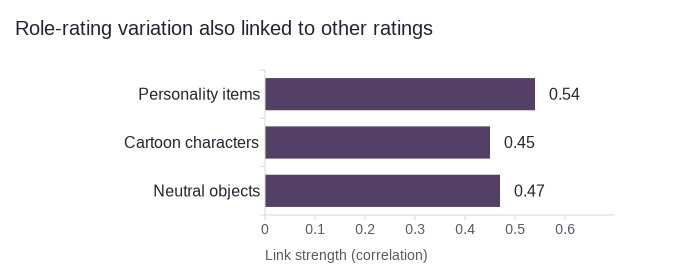
On a small screen, scroll the chart sideways. The table below shows the same values.
| Variation in ratings of | Correlation with self-rating variation across roles |
|---|---|
| Personality items | 0.54 |
| Cartoon characters | 0.45 |
| Neutral objects | 0.47 |
A second study followed daily answers
The second study began with 252 students. Daily reports were collected over two weeks within the broader study, and the main complete-data tables used 203 participants. The abstract gives a different total of 202, so the number depends on which part of the report is being described.
This time, participants gave daily personality, emotion and self-esteem ratings. They also rated a friend’s personality, neutral objects and the weather. The participant records had been used in an earlier questionnaire study, so this was a new analysis of existing data rather than a wholly new recruitment.
Links between personality variability and some unrelated ratings appeared again. Weather ratings showed weaker links, which did not fit the researchers’ expectation as neatly. After adjusting for average scores, most links between personality variability and well-being, such as satisfaction with life, were small. There were exceptions, especially involving variation in positive emotions.
Why this is a caution rather than a final answer
The studies were observational and relied on student self-reports. They did not directly observe all the behaviour they aimed to describe. A common answering style is a plausible explanation for some of the connections, but the studies do not prove that it explains them all.
Other explanations remain possible. People may use their own experiences when guessing about a friend. Even the supposedly neutral objects may mean different things to different people. The weather test was also imperfect, and the paper describes the weather questions inconsistently in different sections.
What a reader should take from it
This paper does not show that personality never changes across situations. It shows why a changing number needs careful interpretation. A reliable pattern in questionnaire answers can still contain influences other than the behaviour researchers want to measure.
It also does not justify labelling someone inconsistent, unhealthy or dishonest because some of their answers differ. Different questions can cover different parts of a broad trait. Corky does not use this research to turn answer variation into a diagnosis or a new personality trait.
Read the full research
For more detail, including the methods and results, follow the links to the original research below.
Brendan M. Baird, Richard E. Lucas, M. Brent Donnellan (2017). The Role of Response Styles in the Assessment of Intraindividual Personality Variability Journal of research in personality.
Open the original publication ↗
Read the full text in PubMed Central ↗
DOI: 10.1016/j.jrp.2016.06.015
This is Corky’s explanation of the research. The original authors and journal own their work. The study’s measures are not automatically equivalent to Corky’s questionnaire.