Explanation of a conceptual framework for personality consistency
Personality can be consistent in more than one way
A conceptual framework explains why stability, averages and responses to situations are different questions.
In this explanation
Quiet on average is different from quiet every time
A person may speak little in a large group and talk freely with a close friend. If someone calls that inconsistent, they may mean the behaviour changed between settings. If someone calls it consistent, they may mean the person behaves that way in each of those settings repeatedly.
Both descriptions can be understandable once the question is clear. This imagined example introduces William Fleeson and Erik Noftle’s framework for distinguishing different meanings of personality consistency.
The framework separates three decisions
The authors organised 36 consistency concepts along three dimensions. One concerns what changes across a comparison: time, the situation or the behaviour being examined. Another concerns what is being described: a single action, an average, a response linked to a condition or a broader pattern.
The third concerns how consistency is judged: an absolute level, a position relative to other people or similarity in a person’s profile. The combinations form a way to organise questions. They are not 36 new personality traits or findings from 36 newly conducted studies.
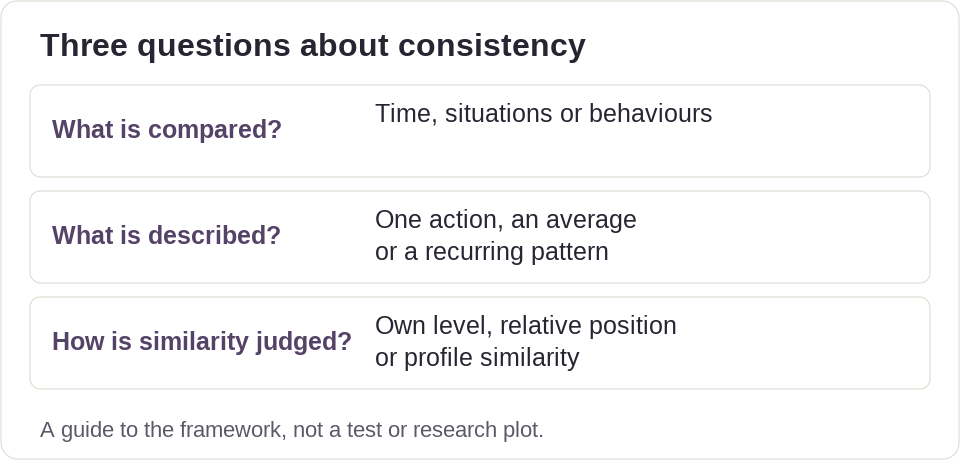
On a small screen, scroll the illustration sideways. The table below explains the same sequence.
| Question | Examples of what to specify |
|---|---|
| What is compared? | Time, situations or behaviours |
| What is described? | One action, an average or a recurring pattern |
| How is similarity judged? | Own level, relative position or profile similarity |
The comparison changes the meaning
Consider an imagined person who becomes more talkative over several years. They could still be quieter than most people in their comparison group. Their own level changed, while their relative position might remain similar. Neither description makes the other false.
Likewise, an average across a week could stay similar even though particular days differ greatly. A recurring response to a familiar situation could also remain while the overall average changes. These examples illustrate logical distinctions in the framework, rather than numerical results from the paper.
A useful description says what stayed similar
This is a conceptual organising paper, rather than a new test that can decide whether a particular individual is consistent. Applying its ideas requires suitable observations and a clear comparison. A questionnaire about general tendencies does not automatically supply a record of behaviour in each setting.
The word consistent becomes more informative when it is followed by a description: similar across weeks, similar relative to others, or similar when a certain situation occurs. That leaves room for recognisable tendencies and ordinary variation within the same person. Change in one sense need not erase continuity in another.
Read the full research
For more detail, including the methods and results, follow the links to the original research below.
Fleeson W, Noftle EE (2008). Where does personality have its influence? A supermatrix of consistency concepts. Journal of personality.
Open the original publication ↗
Find the full paper at the source ↗
DOI: 10.1111/j.1467-6494.2008.00525.x
This is Corky’s explanation of the research. The original authors and journal own their work. The study’s measures are not automatically equivalent to Corky’s questionnaire.