Three online studies of restarting a computer game
Getting started again after an interruption
Three game studies examined a small act of restarting, while leaving broader work habits and underlying causes uncertain.
In this explanation
A simple way back can still involve hesitation
An interruption can leave you knowing what to do next without immediately doing it. Max Birk and colleagues studied a very small version of that situation: a computer game paused, and the player could click a button to carry on or wait for a timer to finish.
The researchers asked whether this behaviour was associated with a questionnaire about getting started under demanding conditions. They were not measuring someone’s overall worth, work performance or ability to deal with every interruption.
What the players experienced
The three online studies analysed 208, 457 and 210 participants recruited through the online platform Mechanical Turk. Most regularly played digital games. They played a game in which matching coloured pieces earned points. A message claiming a lost network connection appeared either during a round or after a round had finished. The interruption was simulated.
The first two studies varied the order of these two situations across participants. The message disappeared automatically after 60 seconds in the first study and after 10 seconds in the second. In the third study, an after-round message came first, followed by several interruptions during later rounds. The studies formed one research programme using a similar task and recruitment platform.
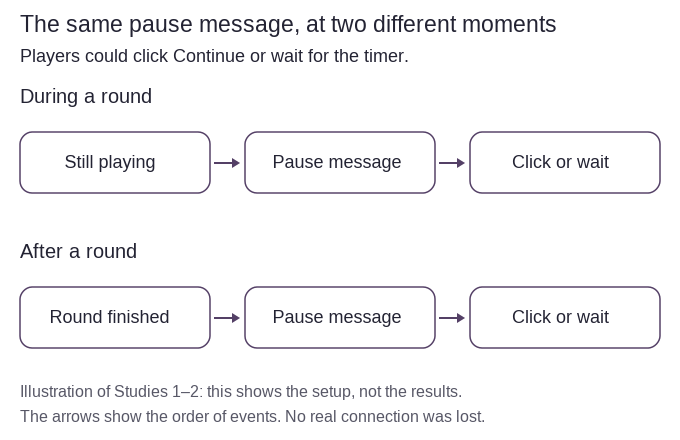
On a small screen, scroll the illustration sideways. The table below explains the same sequence.
| Study condition | When the message appeared | Available response |
|---|---|---|
| During a round | Before the round was finished | Click Continue or wait for the timer |
| After a round | After the round was finished | Click Continue or wait for the timer |
What the questionnaire measured
The researchers distinguished two tendencies: getting going rather than hesitating when something needs doing, and moving on rather than remaining caught up in a failure or threat. They measured these with separate parts of the Action Control Scale. Those research scores are not Corky’s planning or emotional preference scores.
Players also reported their experience of the game, including enjoyment and perceived effort. The main outcomes were whether they clicked to dismiss the message and how long they took. Waiting was a possible response built into the task; it was not, by itself, proof that someone lacked motivation or skill.
What the authors reported
The authors report that higher scores for getting started under demands were associated with being more likely to dismiss an interruption during a round, after accounting for dismissal after a round and several other measurements. The corresponding score about dealing with failure did not show the same clear pattern.
The differences were small. The overall difference between interruptions during and after a round was clearer in the first study than in the second. These findings concern a narrow clicking task; they do not show that one broad kind of person always handles interruptions better.
Repetition and the way waiting was counted
In the third study, the reported link was present at the first interruption during play but was no longer statistically clear at later repetitions. People may have become familiar with the situation. Because the order was fixed and there was no comparable group without repeated exposure, this does not establish a general training method.
The timing analysis also counted a person who never clicked as waiting for the full timer. When the researchers analysed only people who dismissed the messages, the questionnaire score did not clearly distinguish how fast they clicked. Whether someone acts and how quickly they act after deciding to do so are different questions.
Why the interpretation needs care
Some numerical entries in the paper do not agree with one another. In its main regression table, several coefficient signs conflict with the reported odds ratios and the explanation in the text. The same entries appear in the university-hosted published PDF. We therefore describe the authors’ reported pattern cautiously and do not turn those estimates into precise forecasts.
The study did not directly measure the proposed emotional and memory processes behind restarting. Motivation was measured after the game, so accounting for those answers cannot rule out every motivational explanation. The experiments also did not test whether clicking behaviour predicts real workplace performance, a mental-health condition or the benefits of repeated interruptions.
What this means for Corky
The useful distinction is between wanting to continue, starting again and performing the task well. The study examines one small behaviour in a particular setting. A person who waits through a game message should not be assigned a general label from that act.
Corky does not measure action–state orientation through its planning questions. It cannot infer your response to notifications, self-regulation skill or need for a particular intervention from a personality category. This research offers context for asking better questions about interruptions; it does not add a new score or a performance prediction.
Read the full research
For more detail, including the methods and results, follow the links to the original research below.
Max V Birk, Regan L Mandryk, Nicola Baumann (2020). Just a click away: Action-state orientation moderates the impact of task interruptions on initiative. Journal of personality.
Open the original publication ↗
Read the full text in PubMed Central ↗
DOI: 10.1111/jopy.12498
This is Corky’s explanation of the research. The original authors and journal own their work. The study’s measures are not automatically equivalent to Corky’s questionnaire.