Study of four hypothetical financial choices
A risky choice can change with the situation
In four imaginary-money choices, the same group took more risks to avoid losses than to pursue gains. The study does not establish anyone’s financial risk profile.
In this explanation
The question the study asked
A person who chooses a guaranteed gain may accept uncertainty when faced with a guaranteed loss. This paper examined whether choices varied across four financial scenarios, and whether measured personality traits were associated with those differences.
The word risky has a narrow meaning here: selecting the option with an uncertain outcome. It does not automatically mean foolish, impulsive or financially harmful. The study measured choices between specific alternatives, rather than the quality of a person’s financial decisions.
What participants chose between
The study involved 310 Polish adults recruited through an online research panel. Their ages ranged from 18 to 92. Each person answered four hypothetical lottery questions in a random order and completed the 60-item HEXACO personality questionnaire.
For a smaller gain, the choice was a certain 3,000 Polish złoty or an 80% chance of gaining 4,000 and a 20% chance of gaining nothing. Another question used the same amounts as losses. Two further questions multiplied those amounts by 100. No participant actually received or lost these sums.
The clearest difference was between scenarios
About 26% chose the uncertain option for the smaller gain, and about 20% for the larger gain. For the loss questions, about 55% and 58% chose the uncertain option. Those percentages describe the 310 people in this study, not a forecast for everyone.
The loss option offered a chance of losing nothing, which may have made it attractive even though it carried the possibility of a larger loss. The same people answered all four questions. There were 1,240 answers, but still only 310 participants.
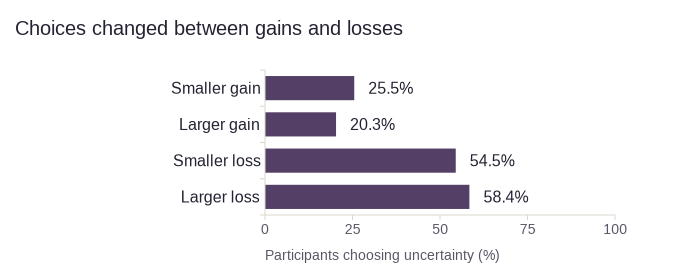
On a small screen, scroll the chart sideways. The table below shows the same values.
| Hypothetical scenario | Chose uncertain option | Participants |
|---|---|---|
| Smaller gain | 25.5% | 79 of 310 |
| Larger gain | 20.3% | 63 of 310 |
| Smaller loss | 54.5% | 169 of 310 |
| Larger loss | 58.4% | 181 of 310 |
The personality findings were more tentative
The authors reported that Honesty–Humility was associated with less risky choice overall, while the other broad traits did not show clear overall associations. Further analyses suggested that the links involving Honesty–Humility and conscientiousness depended on the scenario.
One unexpected finding was that higher conscientiousness was associated with choosing the uncertain option in loss scenarios. This does not mean organised people are generally reckless. It is an unreplicated association in a very limited set of tasks, and the study did not measure the reasoning behind the choices. Some model estimates also differ across tables and the probability display, so precise trait-based predictions would be inappropriate.
Why the tasks do not isolate a pure appetite for risk
The options differed in their average expected outcomes as well as their uncertainty. Across many imagined repetitions, the smaller gain lottery would average 3,200 złoty, compared with the certain 3,000. In the corresponding loss question, the lottery would average a loss of 3,200 rather than 3,000. Preferences could therefore reflect more than uncertainty alone.
There was only one question for each combination of gain or loss and smaller or larger amounts. The very large sums may have been hard to imagine realistically. The study did not include real financial consequences, a broad set of risk tasks or an independent replication. Personality was observed rather than changed, and possible demographic influences were not fully examined.
What the findings can help us understand
The results illustrate why a decision should be read alongside its options, stakes and wording. A single choice cannot safely become a permanent label for a person.
Corky does not measure financial risk tolerance, Honesty–Humility or investment skill. Its personality results cannot use this paper to recommend financial actions or predict whether a user will gamble, save or invest well. The value here is understanding the limits of a personality shortcut.
Read the full research
For more detail, including the methods and results, follow the links to the original research below.
Bartosz Wiszniewski, Hanna Liberska (2026). HEXACO Personality Traits and Risky Choices in Hypothetical Financial Lotteries: A Repeated-Measures Study Behavioral Sciences.
Open the original publication ↗
Read the full text in PubMed Central ↗
DOI: 10.3390/bs16081389
This is Corky’s explanation of the research. The original authors and journal own their work. The study’s measures are not automatically equivalent to Corky’s questionnaire.