Four studies of first impressions and trust
Being outgoing and being trusted are different
Four studies examined whom people chose to trust. Agreeable descriptions mattered more consistently than outgoing descriptions, but impressions did not establish honesty.
In this explanation
The question
An outgoing person may make a strong first impression. Does that also make other people more willing to trust them? This paper compared outgoingness, or extraversion, with agreeableness: a broad tendency involving consideration and cooperation.
The researchers mainly studied trust decisions and impressions. That distinction matters. Being chosen as someone to trust does not establish that a person will keep a promise or return money. The paper helps separate those ideas.
Two experiments with descriptions of a stranger
In the first experiment, 258 participants made a money-transfer decision after reading a description of a supposed partner. The descriptions varied whether the partner was outgoing or quiet, and considerate or inconsiderate. The researchers paid a small randomly selected group according to the game’s arrangement.
Participants were more willing to send money to a partner described as agreeable. An outgoing description did not reliably increase that choice. Because the descriptions were assigned at random, the experiment supports an effect of the descriptions on choices in this particular setting. It does not establish what people with those traits would actually do.
A second experiment used different descriptions and a hypothetical transfer, rather than a real payout. It again found a clearer effect of the agreeable description than of the outgoing description. Participants also rated how much they liked the partner and how trustworthy the partner seemed. Liking alone did not explain the whole pattern.
The paper reports 287 people in that second analysis, although its recruitment and exclusion figures do not add up exactly to that total. That reporting inconsistency is a reason to avoid treating every detail as settled.
A brief group-work study gave weaker evidence
The third study brought psychology students at a Dutch university together for about 20 minutes of tasks. They had completed a personality questionnaire beforehand. After working together, they ranked which group members they would be most willing to trust with money.
The final analysis included 206 participants, mostly women and around 20 years old. More agreeable participants were rated slightly higher for trust. Outgoingness did not show the same association. But the agreeableness result was small and changed in statistical strength depending on which other traits were included.
This part was exploratory and had not been registered in advance. It offers suggestive evidence, rather than a strong demonstration of how trust develops at work. A short student exercise is not the same as a long working relationship.
People changed what they said about themselves
In the fourth study, 258 participants answered personality questions. Some were told their answers would be shown to a potential partner deciding whether to send them money. Others were asked to answer privately and accurately.
The group expecting to be seen reported higher agreeableness, averaging 5.68 rather than 5.18 on a seven-point scale. There was no comparable reliable increase in outgoingness. This shows that the setting in which people answer can affect their self-description.
The researchers also examined how much money people chose to return. In these exploratory analyses, neither reported agreeableness nor outgoingness had a reliable association with the amount returned. The evidence about being trusted was clearer than the evidence about acting trustworthily.
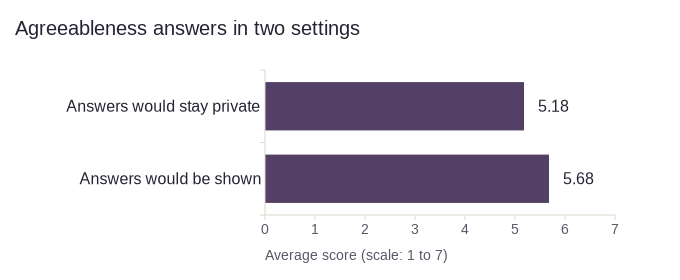
On a small screen, scroll the chart sideways. The table below shows the same values.
| Answer setting | Average score (1 to 7) | Standard deviation |
|---|---|---|
| Private | 5.18 | 0.79 |
| Would be shown to a partner | 5.68 | 0.86 |
What needs caution
The experiments used brief, sometimes sharply positive or negative descriptions. Real people provide mixed information over time. One experiment was hypothetical, and the group-work result came from a narrow student sample with many exclusions.
Not finding a reliable outgoingness effect here does not prove outgoingness has no role in trust in every setting. The studies also do not tell us exactly which behaviour made someone seem trustworthy. Statistical pathways through liking or moral impressions are possible explanations, rather than proof of a single psychological mechanism.
The questionnaires and descriptions used particular definitions of agreeableness. Other measures split kindness, honesty and cooperation differently. A broad trait label cannot be treated as a guarantee of any one of those qualities.
What this means in everyday language
Being noticeable, being liked, being trusted and keeping trust are separate things. This research gives a reason to keep those distinctions when interpreting a first impression. It does not provide a dependable way to identify honest people from personality scores.
Corky’s result cannot establish whether someone is safe to trust or predict how others will judge them. The useful lesson here is about the limits of an impression, alongside the importance of checking what a study actually measured.
Read the full research
For more detail, including the methods and results, follow the links to the original research below.
Olga Stavrova, Anthony M. Evans, Ilja van Beest (2023). The Effects of Partner Extraversion and Agreeableness on Trust Personality & Social Psychology Bulletin.
Open the original publication ↗
Read the full text in PubMed Central ↗
DOI: 10.1177/01461672221086768
This is Corky’s explanation of the research. The original authors and journal own their work. The study’s measures are not automatically equivalent to Corky’s questionnaire.