Explanation of French BFI-2 informant forms
A short personality form can keep the broad view and lose detail
French informant-report research compared short and extra-short BFI-2 forms with different levels of coverage.
In this explanation
A summary can be useful without containing every detail
A short description of a friend may capture their general character while leaving out differences that would matter in a longer conversation. Questionnaire length involves a similar choice: which level of detail is the form intended to preserve?
Baptiste Lignier and colleagues studied French short and extra-short informant versions of the Big Five Inventory-2. Informants answer about someone they know, rather than describing themselves.
The two short forms had different ambitions
The researchers asked 1,445 psychology and sport-science students to describe a known person; 1,380 descriptions were completed. The 30-item short form covers five broad domains and 15 narrower facets. The 15-item extra-short form covers the broad domains, rather than providing those 15 facet scores.
The reported models fitted the responses well, with generally appropriate item relationships and high correlations with the full 60-item form. The study also reported small or negligible differences in item functioning by age and gender that could not explain group score differences.
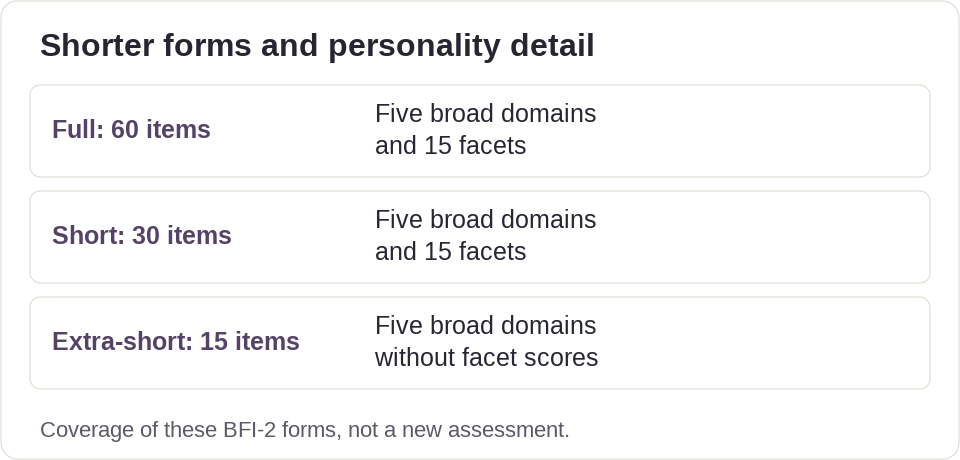
On a small screen, scroll the illustration sideways. The table below explains the same sequence.
| Form | Items | Intended detail |
|---|---|---|
| Full BFI-2 | 60 | Five broad domains and 15 facets |
| BFI-2-S | 30 | Five broad domains and 15 facets |
| BFI-2-XS | 15 | Five broad domains; no facet scores |
Strong overlap needs the right interpretation
Short-form scores that use items from the full questionnaire will share some of the same answers with it. Their high correlation is useful information, but it is not the same as an independent assessment agreeing with a completely separate set of observations.
Nor does a well-performing broad score mean every narrower facet can be recovered from fewer questions. The distinction between the short and extra-short forms helps make that tradeoff visible.
Choose the level of detail the evidence can support
These were descriptions made by students about known people. The authors identify uncertainty about generalising to less-educated informants. The findings also belong to these French forms; they do not validate a different questionnaire or every translation.
A shorter form can be a sensible choice when its purpose matches its coverage. The honest description says what it preserves and what it leaves out, so a broad overview is not mistaken for a detailed portrait.
Read the full research
For more detail, including the methods and results, follow the links to the original research below.
Lignier B, Petot JM, De Oliveira P, Nicolas M, Canada B, Courtois R, John OP, Plaisant O, Soto CJ (2026). Factor structure and psychometric properties of the French Versions of the Big Five Inventory-2 Short (BFI-2-S) and Extra-Short (BFI-2-XS) informant-report forms. L'Encephale.
Open the original publication ↗
Find the full paper at the source ↗
DOI: 10.1016/j.encep.2025.11.004
This is Corky’s explanation of the research. The original authors and journal own their work. The study’s measures are not automatically equivalent to Corky’s questionnaire.