Explanation of a 20-day interpersonal-record study
A recurring pattern can include different responses
Twenty days of interaction records helped distinguish general tendencies from situation-linked patterns.
In this explanation
Different situations can be part of the pattern
Imagine someone who takes a more active part when another person leaves decisions open, but steps back when someone else firmly takes the lead. If that combination recurs, the differences between the situations are part of what needs describing.
This illustration does not establish why either response occurred. It introduces a question Marc Fournier and colleagues studied: how can a general tendency and a consistent pattern across situations both belong to personality?
Participants recorded interactions over 20 days
Participants described their own dominant, agreeable, submissive and quarrelsome behaviour after social interactions. The situations were defined using how they perceived their main interaction partner’s behaviour, combining more or less agreeable behaviour with dominance or submissiveness.
After accounting for the influences of situations common across participants, the remaining variation included consistent differences between people and consistent differences within the same person across situations. The authors described the latter as behavioural signatures. Both kinds of pattern showed a two-dimensional interpersonal structure and stability.
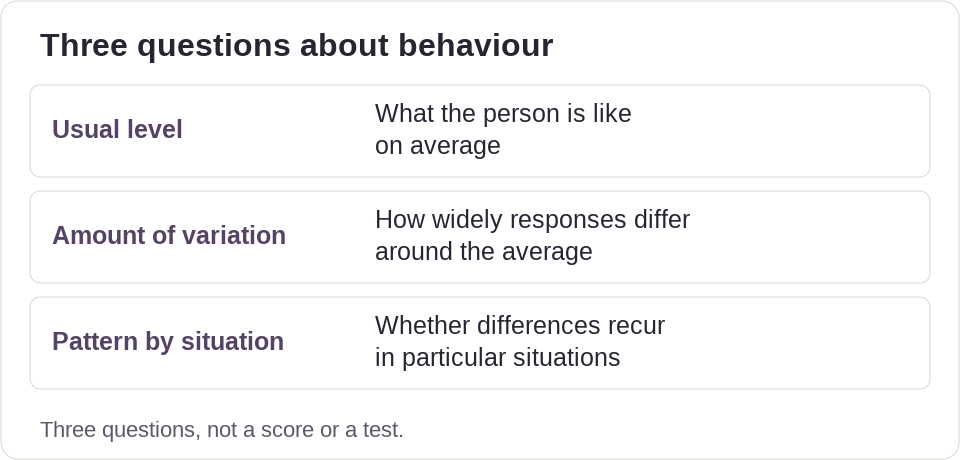
On a small screen, scroll the illustration sideways. The table below explains the same sequence.
| Question | What it concerns |
|---|---|
| Usual level | What the person is like on average |
| Amount of variation | How widely responses differ around the average |
| Pattern by situation | Whether differences recur in particular situations |
A signature is more specific than a broad label
A general disposition concerns an average tendency. A signature concerns how the person’s pattern differs between situations. Identifying one does not automatically identify the other. The study needed repeated, contextual records to examine both.
The example at the beginning could therefore be described without choosing between saying the person always leads and saying they have no recognisable tendencies. It would still require real observations before it could describe any particular individual.
The situation was measured through a person’s report
The records concerned participants’ own behaviour and their perceptions of a partner. They were not an independent video record of everything both people did. The findings also do not establish that every situation-linked response is effective, intentional or caused by the other person.
The useful distinction is that a stable pattern can contain different responses. A broad description may help organise the account, while the circumstances explain what else needs to be observed. The person becomes clearer when both the general tendency and the recurring situational differences are allowed to matter.
Read the full research
For more detail, including the methods and results, follow the links to the original research below.
Fournier MA, Moskowitz DS, Zuroff DC (2008). Integrating dispositions, signatures, and the interpersonal domain. Journal of personality and social psychology.
Open the original publication ↗
Find the full paper at the source ↗
DOI: 10.1037/0022-3514.94.3.531
This is Corky’s explanation of the research. The original authors and journal own their work. The study’s measures are not automatically equivalent to Corky’s questionnaire.